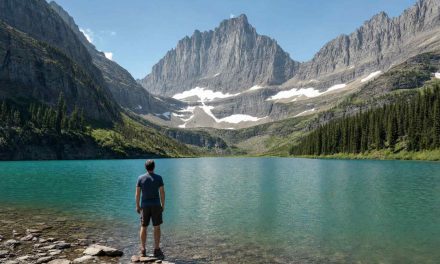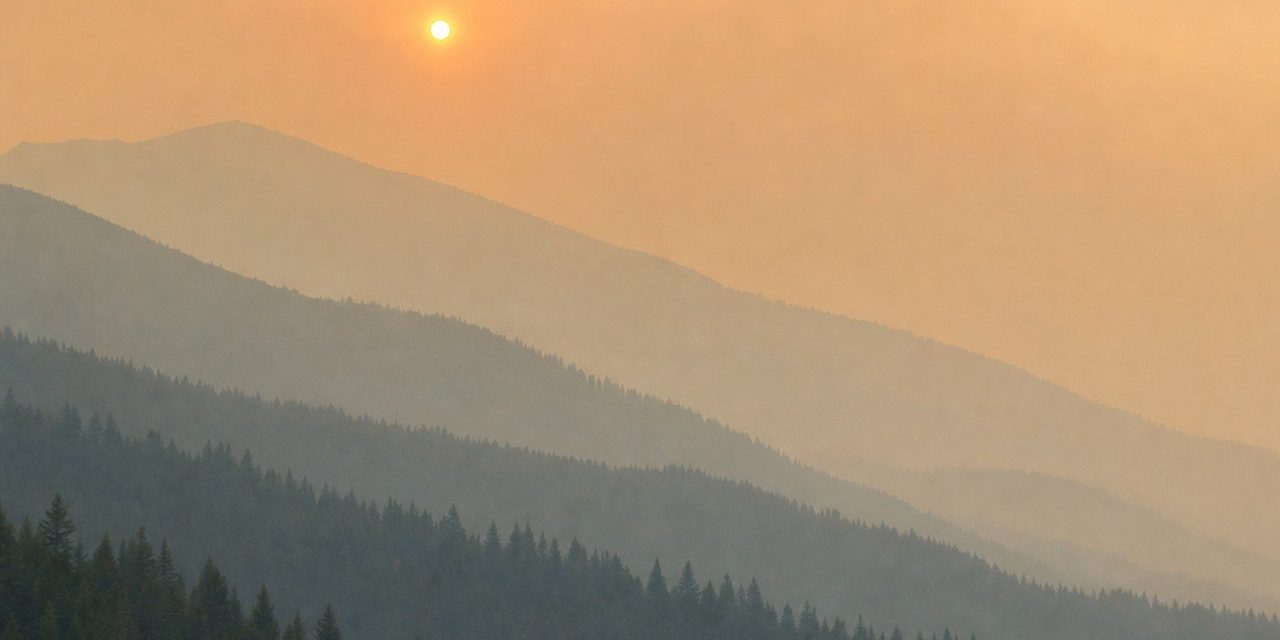
Most people picture a Montana summer as clear blue skies over the mountains. For much of the season that is right. The air-quality data tells a second story that trip planners need to know.
We pulled six years of EPA air-quality records, 2018 through 2023, for two western Montana counties: Missoula, and Flathead, the gateway to Glacier.
The smoke is real, it is a late-summer event, and it varies wildly from year to year.
June is the clean month
Start with the good news.
Across all six years, June had essentially zero days of unhealthy air in either county. By the numbers, early summer in western Montana is clean-air season.
That is the same window when the rivers run full and the high country greens up. June and early July are the safe bet for clear skies.
The smoke lands in August and September
Then fire season arrives.
Counting the days where the Air Quality Index passed 100, the “unhealthy for sensitive groups” line, from 2018 through 2023:
- Missoula: 14 such days in July, 14 in August, 22 in September
- Flathead, Glacier’s county: 26 in August, 13 in September
August and September carry almost all of the smoke risk. The haze tracks the fire calendar, not the vacation calendar.
And it is genuinely smoke. In these counties, nearly every unhealthy-air day in the record was driven by fine particulate matter, the PM2.5 signature of wildfire smoke, not by any other pollutant.
A bad year is very bad
Averages hide the real risk, which is how much the years differ.
In the smoke-heavy summer of 2021, Missoula recorded 30 days with an Air Quality Index over 100. That is a full month of compromised air. In the clean summers of 2018 and 2019, the same county saw only four.
Glacier’s Flathead County tells the same story from the other side: fewer total smoke days, but harder spikes. Its worst single-day readings reached 206 in 2020 and 193 in 2018, deep into the “very unhealthy” range where everyone, not only sensitive groups, should stay inside.
The range runs from four bad-air days to thirty, depending on the fire year. The calendar cannot tell you which one you will get.
What this means for your trip
The smoke data points the same direction as the river data. Late summer in Montana is the conditional season.
- For the clearest air, favor June and early July. It is also when the rivers are at their best.
- Treat August and September as a coin flip. Some years are crystal clear, some are smoked in for weeks.
- Have a low-exertion backup. Smoke days are bad days for hard hikes and long float trips.
- Check each day before you commit. Real-time air quality at AirNow tells you what you are breathing right now, and active fires are listed on InciWeb.
This is the same lesson the flow data teaches about fishing. For that side of it, see when the Big Hole actually fishes and our season-by-season fishing guide. For the practical version on the trail, see hiking in Montana during wildfire season.
A note on the data
The figures here come from the United States Environmental Protection Agency’s daily Air Quality Index records, the EPA AirData archive, for Missoula County and Flathead County, Montana, covering 2018 through 2023. The thresholds follow the standard scale: an index of 101 to 150 is unhealthy for sensitive groups, 151 to 200 is unhealthy for everyone, and 201 and above is very unhealthy.